


In short: Shoulder pain that wakes you at night often comes from the tendons of the rotator cuff. They may be irritated, worn or torn. Frozen shoulder or osteoarthritis can cause similar pain, however, and where it hurts does not on its own give a diagnosis. If the pain has not eased within 2 weeks, is getting worse or you cannot lift your arm, have it examined. Sudden severe pain after a fall, a change in the shape of the shoulder, loss of feeling or a high temperature need a doctor straight away.
Why the shoulder hurts mainly at night
With damage to the rotator cuff tendons, pain at rest and at night is typical, especially when you lie on the affected shoulder. It often comes with pain when raising and lowering the arm, weakness when lifting or rotating the arm and sometimes a crackling sensation when you move the shoulder.
At first the pain may come only when you work with your hands above your head, for example when reaching up to a high shelf. Over time it may also appear at rest and stop responding to ordinary painkillers. Everyday tasks such as combing your hair or reaching behind your back can then become difficult.
The pain can also spread down the arm. That is why the doctor also checks your neck during the examination, to rule out pain coming from a trapped nerve.
The most common causes of shoulder pain at night
- Rotator cuff: irritation, wear or a tear of the tendons. It hurts at night and with arm movements, and the arm may be weaker.
- Tendonitis, bursitis and impingement: impingement means the space for the tendons under the roof of the shoulder is narrowed. The pain is usually worse when you use your arm and shoulder.
- Frozen shoulder: pain and stiffness that last for months. The pain may be worse at night and disturb your sleep.
- Osteoarthritis of the shoulder joint: pain and stiffness that do not go away for months or years.
Only an examination can tell which of these applies to you. How the shoulder tendons become overloaded in sport is described in our article on swimmer's shoulder.
What is the rotator cuff
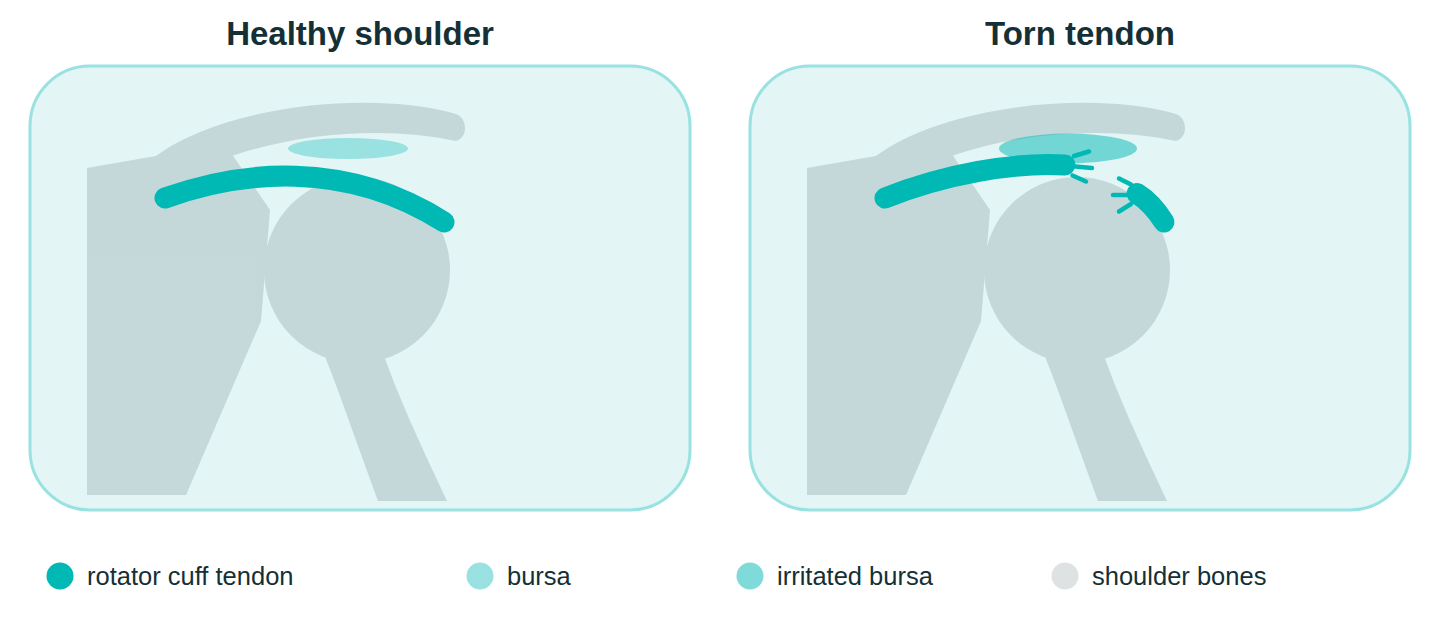
The rotator cuff is a group of four muscles whose tendons cover the head of the upper arm bone. They hold the arm in the socket of the shoulder blade and help to lift and rotate it. Between the tendons and the bone at the top of the shoulder (the acromion) lies a bursa, which lets the tendons glide smoothly when you move. When the tendons are damaged, the bursa can also become inflamed and painful.
Most damage develops from slow wear of the tendon with age: the tendon first frays and may gradually tear. Less often it is caused by an injury, such as a fall on an outstretched arm or lifting something heavy with a jerk. It more often affects people over 40, people who work with their arms above their head and athletes who repeat arm movements, for example in tennis, rowing or weightlifting. Damage is more common in the dominant arm, so in right-handed people on the right.
What you can do yourself
If the pain did not start with an injury and you have none of the warning signs listed below, it usually helps to:
- keep moving and gently exercise the shoulder rather than stop using it altogether
- avoid movements that make the pain worse and do not exercise with heavy weights on your own
- sit and stand upright with your shoulders down and slightly back, and rest your arm on a cushion in your lap when sitting
- use cold or heat wrapped in a towel for up to 20 minutes, two or three times a day
- take ordinary painkillers so that you can keep using the shoulder; a pharmacist can advise you on a suitable one.
Relief usually comes only after about 2 weeks of this routine. Full recovery can take 6 months or longer.
When to see a doctor
Booking an examination
Book an appointment with an orthopaedic specialist if the pain is getting worse or has not improved within 2 weeks, if it is very difficult to move your arm or shoulder, or if the pain and stiffness have lasted for months. Long-lasting shoulder and arm pain is a good reason for an examination, also because a torn tendon can get bigger with continued strain.
When not to wait
See a doctor or go to an emergency department straight away if:
- the pain came on suddenly or is very severe
- you cannot move your arm
- your shoulder or arm has changed shape or is badly swollen
- you have pins and needles that do not go away, or you have lost feeling in your arm or shoulder
- your arm or shoulder feels hot or cold to the touch
- the pain started after an injury or a fall
- both shoulders are very painful
- you have a high temperature or feel generally unwell.
It may be a broken bone, a dislocation or a torn tendon or ligament. A fresh injury is first treated at an accident and emergency department; HR Clinic is not an emergency service. After the initial treatment you can book a follow-up, further treatment or a second opinion with us.
How the examination works

The doctor first asks about your symptoms and how they developed, examines the shoulder and tests its range of movement in different directions and the strength of your arm. An X-ray shows the bones and helps to rule out other causes, such as osteoarthritis. Tendons do not show on it, however, so the X-ray is often normal when the pain comes from the rotator cuff. An ultrasound or MRI scan shows the tendons and any tear, including where it is and how big it is.
Treatment depends on the cause
Treatment without surgery
The aim of treatment is to ease the pain and restore the function of the shoulder. With a rotator cuff tear, treatment without surgery relieves pain and improves shoulder function in many patients. It includes rest and limiting overhead activities, anti-inflammatory medicines, targeted exercises and physiotherapy. If that is not enough, the doctor may consider a corticosteroid injection with a local anaesthetic. It can bring many patients relief for at least 3 months; repeated long-term use carries risks.
Depending on the findings, HR Clinic can also offer cryotherapy, pulsed laser, high-energy shockwave therapy, a combination of laser and shockwave therapy or stem cell application. The doctor decides which approach is suitable after the examination.
When surgery is considered
The doctor considers surgery mainly when the pain does not ease even after treatment without surgery. Other reasons may be symptoms lasting 6 to 12 months, a large tear (over 3 cm) with good-quality surrounding tissue, marked weakness and loss of shoulder function, or a tear after a recent injury. Surgery usually means reattaching the tendon to the upper arm bone.
If a doctor at HR Clinic recommends surgery, it usually takes place within two weeks of the diagnosis, the stay at the clinic lasts no more than 24 hours and rehabilitation follows. The whole process is described on our How it works page.
How the procedure works at HR Clinic is described on our page Shoulder arthroscopy.

Frequently asked questions
Why does my right shoulder hurt at night?
Rotator cuff damage is more common in the dominant arm, so in right-handed people on the right. The side of the pain alone does not give a diagnosis, however; only an examination can tell the cause.
Both my shoulders hurt at night. Should I see a doctor?
Yes. Severe pain in both shoulders is one of the symptoms for which you should see a doctor straight away, especially if it comes with a high temperature or you feel generally unwell.
Do I need a referral for an examination?
No. You do not need a referral from a general practitioner; you can book a consultation online or by phone. Patients pay for care at HR Clinic themselves.
Has shoulder pain been waking you for more than two weeks, or is it limiting your day? Book an orthopaedic consultation at HR Clinic online or call +420 515 225 520.
Updated: 3 November 2026
First published on March 18, 2026.