
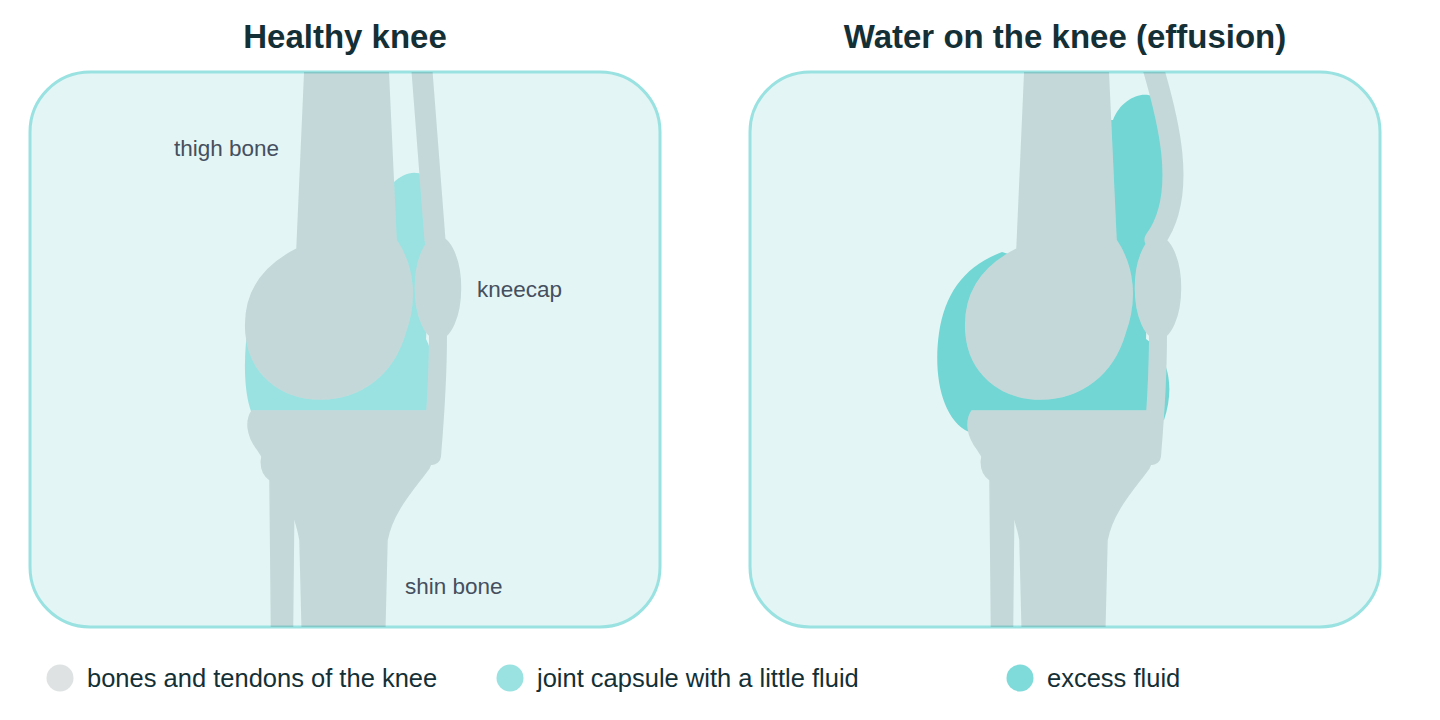
In short: Water on the knee is not a disease in itself but a symptom. The knee swells because the joint is irritated, injured or inflamed. Common causes are osteoarthritis, an injury to the meniscus or ligaments, bursitis, gout or bleeding into the joint. Mild swelling without an injury can often be managed at home with rest and cold packs. If the knee pain has not improved within a few weeks or the swelling keeps coming back, have it examined. A hot, red knee with a high temperature may mean a joint infection and needs a doctor straight away.
What is water on the knee
The knee joint is formed by the lower end of the thigh bone, the upper end of the shin bone and the kneecap. The ends of the bones are covered with smooth joint cartilage, and between the thigh bone and the shin bone lie two menisci that absorb shocks. The whole joint is surrounded by a thin lining, the synovial membrane. It produces joint fluid, which keeps the cartilage moist and reduces friction when you move.
When the knee is irritated, injured or inflamed, more fluid can build up in the joint and the knee swells. A swollen knee with fluid in the joint is therefore a sign that something is going on in the joint, and treatment always depends on the cause.
How to recognise water on the knee: symptoms
Water on the knee usually shows itself in these ways:
- the knee is swollen, sometimes only slightly
- the joint is stiff and the knee will not fully bend or straighten
- the knee hurts, for example when walking or climbing stairs
- with osteoarthritis, pain and swelling are often worse in the morning or after sitting for a long time
- the knee may catch, lock or give way.
What matters is when the swelling appeared and what comes with it. After a meniscus tear, people can often still walk on the knee, and it gradually stiffens and swells over 2 to 3 days. Swelling with warmth and bruising may mean bleeding into the joint, which is more likely in people taking blood-thinning medicines. A hot, red knee with sudden, very severe pain needs a doctor straight away.
Common causes of water on the knee
- Osteoarthritis of the knee: gradual wear of the joint cartilage, most often in people aged 50 and over. Pain and stiffness, often in both knees, and mild swelling are typical.
- Injury to the meniscus, ligaments or cartilage: usually after twisting the knee, often during sport. The knee may be unstable, give way or not straighten, and sometimes a pop is heard at the time of the injury. In older people, a worn meniscus can also tear with an awkward twist, for example when getting up from a chair.
- Bursitis: bursae are small fluid-filled sacs that protect the joint. When one is inflamed, the area is warm and may be red, and kneeling or bending makes the swelling and pain worse.
- Bleeding into the joint: swelling, warmth and bruising, more common in people taking blood-thinning medicines.
- Gout or joint infection: a hot, red knee and sudden attacks of very severe pain. A joint infection (septic arthritis) is serious and needs treatment as soon as possible.
- Rheumatoid arthritis: an inflammatory condition in which the joint lining swells. It usually affects the same joint on both sides of the body.
What the swelling looks like only points in a direction; it does not give a diagnosis. Only an examination can tell the cause. How to prevent knee injuries on the slopes is described in our article on preventing injuries when skiing.
What you can do yourself
If the swelling did not start with an injury and you have none of the warning signs listed below, it usually helps to:
- put as little weight on the knee as possible and avoid standing for long periods
- put a cold pack or a bag of frozen vegetables wrapped in a towel on the knee for up to 20 minutes every 2 to 3 hours
- keep your leg raised higher than your heart when resting
- take ordinary painkillers, such as paracetamol or ibuprofen as a gel or tablets.
You should notice an improvement within a few days. If the knee pain has not improved within a few weeks, book an examination.
When to see a doctor
When not to wait
See a doctor or go to an emergency department straight away if:
- the knee is hot or red and you have a high temperature, shivers or feel generally unwell, because it may be a joint infection
- the knee pain came on suddenly and is very severe
- you cannot move the knee or stand on the leg
- the knee is badly swollen or has changed shape
- the knee locks, gives way or clicks painfully (clicking that does not hurt is normal)
- after knee surgery you have severe or increasing swelling, redness, a high temperature or discharge from the wound.
A joint infection usually develops quickly, within a few days, and is mostly treated in hospital. A fresh injury, such as a fracture or a dislocated kneecap, is first treated at an accident and emergency department; HR Clinic is not an emergency service. After the initial treatment you can book a follow-up, further treatment or a second opinion with us.
When to book an examination
Book an appointment with an orthopaedic specialist if the pain and swelling have not improved within a few weeks, if the water on the knee keeps coming back, if knee pain and stiffness limit you over a long period, or if the knee gives way or catches after an earlier injury. A planned examination is also advisable if a damaged meniscus or cartilage is suspected and if you have known osteoarthritis.
How the examination works

The doctor asks when and how the swelling started and examines the knee, looking for swelling, warmth or redness and tender spots, testing the range of movement and the stability of the joint and watching how you walk. Tenderness where the meniscus lies and a test that bends, straightens and rotates the knee can point to a damaged meniscus.
An X-ray shows the bones and signs of osteoarthritis, such as a narrowed joint space or bony growths. The meniscus does not show on it. An MRI scan shows the menisci, cartilage, tendons and ligaments; sometimes ultrasound is used. If needed, the doctor adds blood tests.
The doctor may also use a needle to take a sample of fluid from the joint (joint aspiration). The fluid is tested for infection or gout, and draining it can also relieve the symptoms.
Treatment depends on the cause
Treatment without surgery
Treatment usually starts without surgery. Depending on the cause, options include rest and cooling, medicines to ease pain and inflammation, physiotherapy with targeted exercises and, for an infection, antibiotics. The doctor can also ease swelling and pain with a corticosteroid injection into the joint. Its effect is not permanent, however; injections into one joint are usually given no more than three to four times a year and are not given if there is an infection.
What helps with osteoarthritis of the knee
Osteoarthritis is a long-term condition that does not go away for good. But it does not necessarily get worse, and the symptoms can be eased. It helps to:
- exercise regularly, ideally in a way that is gentle on the knees, for example swimming or cycling instead of running
- lose weight if you are overweight, because excess weight puts strain on the knees
- have physiotherapy and do exercises to strengthen the leg muscles
- use warm or cold compresses
- take medicines for pain and inflammation, for the knee also as a gel
- use a knee support or a walking stick to take the load off the joint.
According to the available evidence, food supplements containing glucosamine or chondroitin do not slow osteoarthritis. For early joint wear, HR Clinic also offers treatment with plasma from your own blood or with stem cells from fatty tissue. Expert sources consider these treatments promising, but clinical studies have not yet confirmed their benefit in osteoarthritis. The doctor will assess whether they make sense in your case.
If pain still severely limits everyday life despite this treatment, surgery may be considered. Depending on the extent of the damage, this is either a procedure that preserves your own joint, such as correcting the alignment of the leg (osteotomy), or a partial knee replacement.
When arthroscopy is an option
Arthroscopy is surgery through small cuts. The surgeon inserts a thin camera with a light into the knee, sees the inside of the joint on a screen and treats what is needed through other small openings. At the start of the procedure, the joint is filled with a sterile fluid that rinses out cloudy fluid so that the inside of the knee can be seen clearly.
With water on the knee, the doctor considers arthroscopy mainly when the symptoms do not ease after treatment without surgery and the cause is damage inside the joint, for example:
- a torn meniscus, especially if the knee locks or swells
- loose pieces of cartilage or bone in the joint
- an inflamed joint lining
- damaged cartilage or a torn cruciate ligament.
For osteoarthritis of the knee on its own, arthroscopy is not usually used. It may make sense when the osteoarthritis comes with a meniscus torn through wear. Most knee arthroscopies take less than an hour. People usually return to most activities within 6 to 8 weeks; recovery takes longer after a meniscus repair or ligament reconstruction.
At HR Clinic, the consultation and any arthroscopy are led by Prof. Radek Hart, MD, PhD. The clinic has optics for 4K arthroscopy and nanoscopy, a gentle examination of the knee joint with fine optics under local anaesthetic. The doctor decides whether it is suitable. If surgery is recommended, it usually takes place within two weeks of the diagnosis and is followed by rehabilitation. The process from booking to rehabilitation is described on our How it works page.
How the procedure works at HR Clinic is described on our page Knee arthroscopy and meniscus.
Frequently asked questions
Can water on the knee go away on its own?
Mild swelling without an injury often settles with rest, cooling and painkillers, and you should notice an improvement within a few days. If the knee pain has not improved within a few weeks or the swelling keeps coming back, have it examined.
Why does water on the knee keep coming back?
Swelling can keep returning as long as its cause persists, for example osteoarthritis, a damaged meniscus or an inflammatory joint condition. Draining the fluid can bring relief, but further treatment depends on the cause, which an examination will show.
How is fluid drained from the knee?
The doctor inserts a needle into the joint and removes fluid (joint aspiration). The sample is tested, for example for infection or gout, and draining the fluid can also relieve the symptoms.
Is a swollen knee after arthroscopy normal?
After arthroscopy the joint is often painful and stiff at first and may swell. Cooling and keeping the leg raised help. Severe or increasing swelling or redness, a high temperature, smelly discharge from the wound or numbness around the joint are reasons to contact a doctor or the clinic where the procedure took place straight away.
Do I need a referral for an examination?
No. You do not need a referral from a general practitioner; you can book a consultation online or by phone. Patients pay for care at HR Clinic themselves.
Do you keep getting water on the knee, or is the swelling not going down? Book an orthopaedic consultation at HR Clinic online or call +420 515 225 520.
Updated: 13 October 2026